Like us on Facebook

Showing posts with label Sympathy. Show all posts

Saturday, 27 March 2021

Hope sees the Invisible

(WhatsApp Forward)

Dr. Frank Mayfield (1908-1991, a renowned Neurosurgeon in the US) was touring Tewksbury Institute when, on his way out, he accidentally collided with an elderly floor maid. To cover the awkward moment Dr. Mayfield started asking questions.

"How long have you worked here?"

"I've worked here almost since the place opened," the maid replied.

"What can you tell me about the history of this place?" he asked.

"I don't think I can tell you anything, but I could show you something."

With that, she took his hand and led him down to the basement under the oldest section of the building. She pointed to one of what looked like small prison cells, their iron bars rusted with age, and said, "That's the cage where they used to keep Annie Sullivan."

"Who's Annie?" the doctor asked.

Annie was a young girl who was brought in here because she was incorrigible—nobody could do anything with her. She'd bite and scream and throw her food at people. The doctors and nurses couldn't even examine her or anything. I'd see them trying with her spitting and scratching at them.

"I was only a few years younger than her myself and I used to think, 'I sure would hate to be locked up in a cage like that.' I wanted to help her, but I didn't have any idea what I could do. I mean, if the doctors and nurses couldn't help her, what could someone like me do?

"I didn't know what else to do, so I just baked her some brownies one night after work. The next day I brought them in. I walked carefully to her cage and said, 'Annie, I baked these brownies just for you. I'll put them right here on the floor and you can come and get them if you want.'

"Then I got out of there just as fast as I could because I was afraid she might throw them at me. But she didn't. She actually took the brownies and ate them. After that, she was just a little bit nicer to me when I was around. And sometimes I'd talk to her. Once, I even got her laughing.

One of the nurses noticed this and she told the doctor. They asked me if I'd help them with Annie. I said I would if I could. So that's how it came about that. Every time they wanted to see Annie or examine her, I went into the cage first and explained and calmed her down and held her hand.

This is how they discovered that Annie was almost blind."

After they'd been working with her for about a year—and it was tough sledding with Annie—the Perkins institute for the Blind opened its doors. They were able to help her and she went on to study and she became a teacher herself.

Annie came back to the Tewksbury Institute to visit, and to see what she could do to help out. At first, the Director didn't say anything and then he thought about a letter he'd just received. A man had written to him about his daughter. She was absolutely unruly—almost like an animal. She was blind and deaf as well as 'deranged.'

He was at his wit's end, but he didn't want to put her in an asylum. So he wrote the Institute to ask if they knew of anyone who would come to his house and work with his daughter.

And that is how Annie Sullivan became the lifelong companion of Helen Keller.

When Helen Keller received the Nobel Prize, she was asked who had the greatest impact on her life and she said, "Annie Sullivan."

But Annie said, "No Helen. The woman who had the greatest influence on both our lives was a floor maid at the Tewksbury Institute."




Tuesday, 6 May 2014

Listening skills

Excerpts from Steve Goodier www.LifeSupportSystem.com

Joe, a 22-year-old electrician went to Manhattan a few days after the September 11, 2001 attacks on the World Trade Center buildings. He wanted to volunteer his time, but discovered that his skills were not needed.

But it turns out that Joe was able to help in a way he never anticipated.

For on the train ride home, he sat across from a weary firefighter who was also traveling home from the scene of the disaster. The firefighter was covered in what appeared to be "ground zero" dirt and debris. Though Joe could see bits of rock in the man's hair and noticed that his hands were bloody, what worried the young man most was the look in the firefighter's eyes. They appeared lifeless and dull.

Then the man, apparently in shock, began to talk and Joe listened.

Joe soon forgot his own disappointment about not being able to volunteer his skills that day as he listened to the gruesome story the firefighter related.

The man told about retrieving a shoe with a foot inside. Joe listened.

He talked about cleaning debris from a face, then discovering that this person's body was gone. Joe continued to listen without flinching.

He did not react in disgust. He did not judge. He did not interrupt. He just listened.

He listened as the firefighter lamented about the carnage everywhere and about shoes...there were so many shoes, he said. Everywhere...shoes.

Through it all Joe quietly held the man's attention and listened, which is exactly what the rescue worker needed at that moment.

And because he listened, the man continued to speak. He talked his pain out, as much as possible. In the presence of a stranger, he tried to put his world back in order, to make sense of the day's chaos.

And Joe, for that time at least, helped him carry his unbelievably heavy burden.

That day Joe did not give blood, nor did he use his electrical skills to help with the relief effort.

But he did one of the most important things a human can do for another. He gave a stunned and disheartened man his whole attention, and thereby, in a small but vital way, assisted in the work of setting the world right.

Mary Lou Casey says, "What people really need is a good listening-to." It's not always easy. And, at times, it may not be fun. In fact, listening closely to another often turns out to be difficult work.

But day in and day out, attentive listening may be one of the most important and satisfying ways we can spend our time.

It's true. What people really need is a good listening-to.


Saturday, 15 February 2014

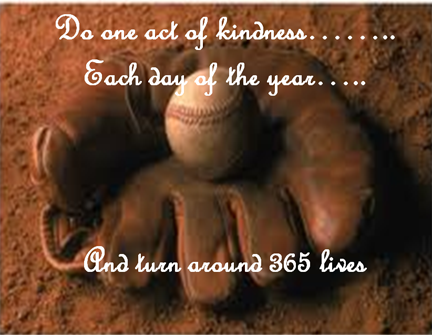
Acts of kindness turn around lives

In one of the training programs for managers, the coordinator asked the participants, “What has caused you to stay long enough to become a manager?"

One participant, with her voice almost breaking, said, "It was a Rs 200 baseball glove."

Mary told the group that she originally took a clerk job as an interim position while she looked for something better.

On her second or third day behind the counter, she received a phone call from her nine-year old son, Bobby. He needed a baseball glove for Little League. She explained that as a single mother, money was very tight, and her first check would have to go for paying bills. Perhaps she could buy his baseball glove with her second or third check.

When Mary arrived for work the next morning, the store manager, asked her to come to the small room in back of the store that served as an office. Mary wondered if she had done something wrong or left some part of her job incomplete from the day before.

She was concerned and confused.

The manager handed her a box. "I overheard you talking to your son yesterday," she said, "and I know that it is hard to explain things to kids. This is a baseball glove for Bobby because he may not understand how important he is, even though you have to pay bills before you can buy gloves. You know we can't pay good people like you as much as we would like to; but we do care, and I want you to know you are important to us."

The thoughtfulness, empathy and love of this store manager is what has caused her to change her mind to look for something better and stay long enough to become a manager.

This demonstrates vividly that people remember more how much an employer cares than how much he pays.

An important lesson for the price of a Little League baseball glove.

My thoughts:
Too often we underestimate the power of a touch, a smile, a kind word, a listening ear, an honest compliment, or the smallest act of caring, all of which have the potential to turn a life around. Acts of kindness does not only benefit receivers of the kind act, but also the giver, as a result of feeling a sense of contentment and relaxation when such acts are committed. 


Wednesday, 5 February 2014

The best help

Author and lecturer Leo Buscaglia once talked about a contest he was asked to judge.

The purpose of the contest was to find the most caring child.

The winner was a four year old child whose next door neighbor was an elderly gentleman who had recently lost his wife.

Upon seeing the man cry, the little boy went into the old gentleman's yard, climbed onto his lap, and just sat there.

When his mother asked him what he had said to the neighbor, the little boy said, "Nothing, I just helped him cry."


Wednesday, 29 January 2014

A cup of Coffee from the wall

Author Unknown 

A man sat with his friend in a well-known coffee shop.

As they enjoyed their coffee, a man entered and sat at an empty table beside them. He called the waiter and placed his order saying, “Two cups of coffee, one of them there on the wall.”

They heard this order with rather interest and observed that he was served with one cup of coffee but he paid for two.

When he left, the waiter put a piece of paper on the wall saying “A Cup of Coffee”.

While they were still there, two other men entered and ordered three cups of coffee, two on the table and one on the wall. They had two cups of coffee but paid for three and left. This time also, the waiter did the same; he put a piece of paper on the wall saying, “A Cup of Coffee”.

It was something unique for them. They finished their coffee, paid the bill and left.

After a few days, they had a chance to go to this coffee shop again. While they were enjoying their coffee, a man poorly dressed entered. As he seated himself, he looked at the wall and said, “One cup of coffee from the wall.”

The waiter served coffee to this man with the customary respect and dignity. The man had his coffee and left without paying.

The waiter took off a piece of paper from the wall and threw it in the trash bin.

Now it was no surprise. The matter was very clear. The great respect for the needy shown by the inhabitants of this town in this manner.

Let us ponder upon the need of what this man wanted.

He enters the coffee shop without having to lower his self-esteem… 
he has no need to ask for a free cup of coffee… 
without asking or knowing about the one who is giving this cup of coffee to him… 
he only looked at the wall, placed an order for himself, enjoyed his coffee and left.

A truly beautiful thought. Probably the most beautiful wall you may ever see anywhere!


Tuesday, 28 January 2014

Understanding others' sufferings

Unknown Author

One young academically excellent person went to apply for a managerial position in a big company.

He passed the first interview, the director did the last interview, made the last decision.

The director discovered from the CV that the youth's academic achievements were excellent all the way, from the secondary school until the postgraduate research, never had a year when he did not score.

The director asked, "Did you obtain any scholarships in school?"

The youth answered, "none".
The director asked, "Was it your father who paid for your school fees?"

The youth answered, "My father passed away when I was one year old, it was my mother who paid for my school fees.”

The director asked, "Where did your mother work?"

The youth answered, "My mother worked as clothes cleaner.”

The director requested the youth to show his hands. The youth showed a pair of hands that were smooth and perfect.

The director asked, "Have you ever helped your mother wash the clothes before?"

The youth answered, "Never, my mother always wanted me to study and read more books. Furthermore, my mother can wash clothes faster than me.”

The director said, "I have a request. When you go back today, go and clean your mother's hands, and then see me tomorrow morning.”

The youth felt that his chance of landing the job was high. When he went back, he happily requested his mother to let him clean her hands. His mother felt strange, happy but with mixed feelings, she showed her hands to the kid.

The youth cleaned his mother's hands slowly. His tear fell as he did that. It was the first time he noticed that his mother's hands were so wrinkled, and there were so many bruises in her hands. Some bruises were so painful that his mother shivered when they were cleaned with water.

This was the first time the youth realized that it was this pair of hands that washed the clothes everyday to enable him to pay the school fee. The bruises in the mother's hands were the price that the mother had to pay for his graduation, academic excellence and his future.

After finishing the cleaning of his mother hands, the youth quietly washed all the remaining clothes for his mother.

That night, mother and son talked for a very long time.

Next morning, the youth went to the director's office.

The Director noticed the tears in the youth's eyes, asked: "Can you tell me what have you done and learned yesterday in your house?"

The youth answered, "I cleaned my mother's hand, and also finished cleaning all the remaining clothes.”

The Director asked, "Please tell me your feelings."

The youth said, 
“1.I know now what appreciation is. Without my mother, there would not the successful me today.
2. By working together and helping my mother, only now I realize how difficult and tough it is to get something done.
3. I have come to appreciate the importance and value of family relationship.”

The director said, "This is what I am looking for in my manager. I want to recruit a person who can appreciate the help of others, a person who knows the sufferings of others to get things done, and a person who would not put money as his only goal in life. You are hired.”


Tuesday, 14 January 2014

The true sight

Author Unknown

The Park bench was deserted as the lady sat down. She was disillusioned with life. “The world is intent on dragging me down,” she thought.

If that weren't enough to ruin her day, a young boy approached her. He was breathless, all tired from play.

He stood right before her with his head tilted down and said with great excitement, "Look what I found!"

There was a flower in his hand, with its petals all worn out. It was a dead flower. Wanting him to take his dead flower and go off to play, she faked a small smile and then pretended to look away.

But instead of retreating he sat next to her side and placed the flower to his nose and declared with overacted surprise, "It sure smells pretty and it's beautiful, too. That's why I picked it; here, it's for you."

She knew she must take it, or he might never leave. So she reached for the flower, and replied, "Just what I need."

But instead of him placing the flower in her hand, he held it mid-air.

It was then that she noticed for the very first time that weed-toting boy could not see: he was blind.

Her voice quivered; tears rolled down as she thanked him for picking the very best one.

"You're welcome," he smiled, and then ran off to play, unaware of the impact he'd had on her day.

She sat there and wondered how he managed to see a self-pitying woman beneath an old willow tree. “How did he know of my self-indulged plight? Perhaps from his heart, he'd been blessed with true sight,” she wondered.

Through the eyes of a blind child, at last she could see that the problem was not with the world; the problem was with her. And for all of those times she herself had been blind.

She vowed to see the beauty in life, and appreciate every second that's hers. And then she held that wilted flower up to her nose and breathed in the fragrance of a beautiful rose.

She smiled as she watched that young boy, with another weed in his hand, about to change the life of an unsuspecting old man.


Sunday, 7 October 2012

The art of comforting

Offering genuine comfort to a grieving person is one of the most important things in life. It is an act of selflessness, as we offer a kind word or a reassuring touch to someone in need of it. But I’m sure all will concur that it is one of the most difficult tasks. Comforting others can be uncomfortable for many of us. We don’t know what to say. We are at a loss for words. We worry we might utter “wrong words” though not intentionally.

But this concern for saying the "wrong words" should not keep us away from comforting a friend or a loved one. Many times what needs to be said can be said best with silent words or by lending a listening ear. Hence, t
he best solution is often to say nothing at all, simply to be present.  Simple expressions of concern are what is most welcome, especially if it comes from a good listener.

Here’s a passage from Mr. Bayly’s "View from a hearse," in which he talks about his grief of losing three children over the course of several years. 


“I was sitting, torn by grief. Someone came and talked to me of God’s dealings, of why it happened, of hope beyond the grave. He said things I knew were true. I was unmoved, except to wish he would go away. He finally did. Someone else came and sat beside me. He didn't talk. He didn’t ask leading questions. He just sat with me for an hour or more, listened when I said something, answered briefly, prayed simply, left. I was moved. I was comforted. I hated to see him go." 

Comforting others isn't always about opening our mouths. In fact, our sympathetic presence and a sympathetic ear may be all that is needed. The suffering person gets more comfort when he is allowed to talk and listened to sympathetically. But it doesn't stop there. We need to pray for the endurance of their suffering too.. Sometimes all that is needed is just to be an attentive listener. Other times, they may want more of a dialogue. 


There isn’t a soul who hasn’t seen hard times at some point or the other, though they present a picture perfect lives of them to the world. Life is giving us an opening to lend a comforting hand to the suffering. Lets grab it.